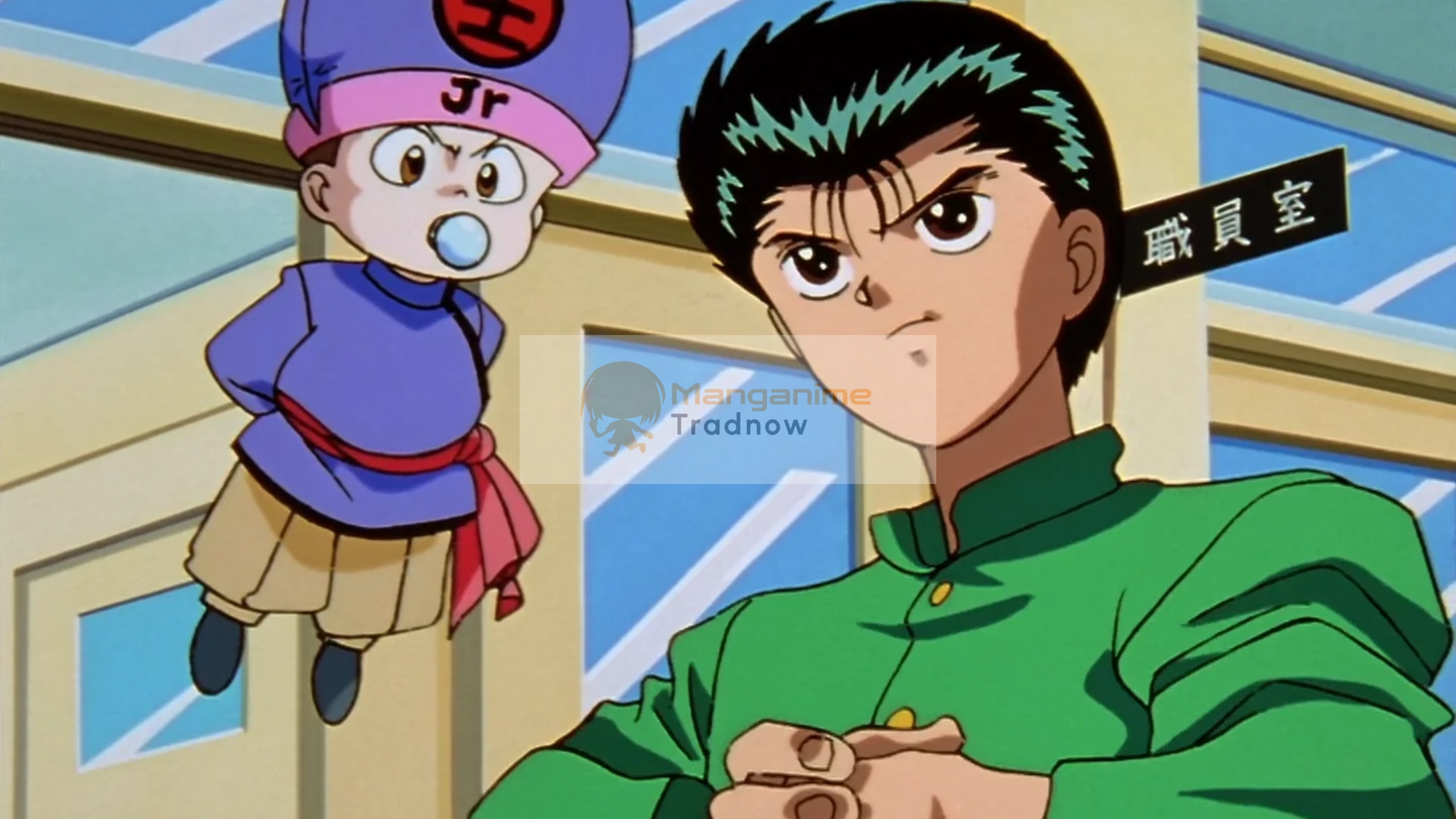
Is Yu Yu Hakusho actually an isekai?
At first, the answer seems obvious: no. It’s usually classified as a supernatural shonen, not a story about being transported to another world. But that answer depends entirely on how you define isekai and more importantly, what you think actually matters in storytelling.
Because when you look past the label and focus on structure, the line becomes much less clear.
In fact, structurally, Yu Yu Hakusho is closer to an isekai than many anime that officially carry the genre.
And that raises a bigger question:
Are we misunderstanding anime genres altogether?
The Problem With How We Define Isekai
Most anime fans recognize isekai by its surface elements:
- A character dies or is transported
- They enter a fantasy or game-like world
- They gain new abilities or status
Anime like Sword Art Online helped popularize this version of the genre, making these elements feel essential.
But there’s a problem with that approach. It focuses on what we see, not how the story actually works.
Because two anime can look completely different on the surface, yet follow the same underlying structure.
And that’s where Yu Yu Hakusho becomes interesting.
What Actually Defines an Isekai (Beyond the Label)
If you strip isekai down to its core, it’s not about fantasy worlds or reincarnation.
It’s about displacement and transformation.
A character is:
- Removed from their normal reality
- Placed into a system with different rules
- Forced to adapt, grow, and redefine who they are
That structural shift more than any setting, is what defines the experience.
And once you start looking at anime this way, a lot of genre boundaries start to break down.
Yu Yu Hakusho’s Structure Tells a Different Story
This is where Yu Yu Hakusho starts to blur the line. Because even if it isn’t labeled as an isekai, it follows that same structural pattern surprisingly closely.
Death as a Complete Reset
Yusuke’s story doesn’t begin with a journey—it begins with his death. That moment isn’t just a dramatic hook. It completely resets his position in the story.
Before:
- A delinquent with no clear direction
After:
- A being tied to the Spirit World
- Given a purpose that no longer belongs to normal human life
This isn’t just character development—it’s a shift in identity.
Entering a Different System
The Spirit World, and later the Demon World, aren’t just new locations. They operate under entirely different rules:
- Different hierarchies
- Different power systems
- Different consequences
Yusuke isn’t just moving through new environments, he’s navigating systems that fundamentally change how reality works for him. And that kind of shift is central to what defines an isekai experience.
Becoming Something Else
Yusuke doesn’t return to his old life unchanged.
He becomes:
- A Spirit Detective
- A mediator between worlds
- A fighter operating under supernatural rules
His role, identity, and limitations all change. And that transformation—not just the setting—is what drives the story forward.
The Key Insight (Where Things Shift)
What Yu Yu Hakusho makes clear is that transformation—not relocation—is what actually defines this type of story.
The shift isn’t just about moving between worlds, it’s about being forced into a completely different system where your identity, role, and limits no longer apply. And once you start looking at anime this way, a lot of genre labels stop making sense. Both are important—but depends on your priority.
Where Modern Isekai Feels Different
The more I looked at Yu Yu Hakusho this way, the more something didn’t add up.
On paper, it shares a lot with isekai.
But when you watch it, it doesn’t feel like one.
And I think the reason comes down to what the story focuses on. Most modern isekai, especially after Sword Art Online, put a lot of attention on the world itself. The rules, the systems, the abilities… sometimes even the “game logic” behind everything.
There’s nothing wrong with that. It’s part of the appeal. But it shifts the focus. Instead of watching a character struggle to adapt, you’re often watching them figure out how to use the system.
With Yu Yu Hakusho, it feels different.
Yusuke doesn’t just get stronger, he’s constantly adjusting to a reality that doesn’t care who he used to be. His role changes. His responsibilities change. Even the way he sees himself changes over time.
And that shift feels a lot more grounded.
Why Yu Yu Hakusho Doesn’t Fit the Label (But Still Feels Close)
Part of the reason Yu Yu Hakusho isn’t seen as an isekai is simple: it never fully leaves the human world behind.
Yusuke is still connected to it.
He moves between:
- The Human World
- The Spirit World
- And later, the Demon World
But he’s not starting a completely new life somewhere else. He’s stuck in between.
And honestly, that makes the story more interesting.
Because instead of escaping one reality for another, he has to deal with both.
He doesn’t get a clean reset, he has to carry everything with him.
That’s a different kind of pressure.
The Moment This Clicked for Me
At some point, I stopped asking:
“Is this an isekai or not?”
And started asking:
“Why does it feel like one even when it isn’t?”
That’s when it clicked.
It’s not about where the story takes place.
It’s about what happens to the character.
Yusuke is pulled out of his normal life, thrown into a completely different system, and forced to figure out who he is inside it.
That’s the same core idea you see in isekai.
Just without the label.
So… Is Yu Yu Hakusho an Isekai?
If you go strictly by genre definitions, then no—Yu Yu Hakusho isn’t an isekai.
It doesn’t follow the usual format:
- No reincarnation
- No permanent relocation
- No fantasy world as the main setting
And officially, it’s still a supernatural shonen.
But the more I think about it, that answer feels incomplete.
Because structurally, it’s doing something very similar.
It breaks the character out of his normal world, puts him into a different system, and builds the story around how he adapts to it.
So maybe the better way to say it is:
It’s not an isekai—but it’s working with the same foundation.
Final Thought
At some point, I realized this isn’t really about whether Yu Yu Hakusho fits into a category.
It’s about how we use those categories in the first place.
Because the more I look at anime this way, the more it feels like genres don’t really explain stories, they just make them easier to label.
And sometimes, that makes us miss what’s actually happening underneath.
Genres tell you what you’re looking at.
But structure tells you what the story is really doing.
What Do You Think?
Do you see Yu Yu Hakusho as something close to isekai?
Or do you think the label still matters more than the structure?

Show Your Work
Whether you are a professional or an amateur, we will love to see your artwork. So don't hesitate to remove your cats from your box right away